


In-House CMO vs. Fractional CMO: Which One Is Right for Your Business?


An in-house CMO is a permanent, full-time executive who owns your marketing function exclusively. A fractional CMO provides the same C-suite marketing leadership on a part-time or project basis without the permanent hire commitment. Both models deliver senior marketing strategy and team leadership. The difference is the structure of the engagement, the level of overhead, and whether your business is at the stage where a full-time executive hire is the right next move.
Key Takeaways:
An in-house CMO is a full-time permanent executive hire. A fractional CMO provides the same strategic leadership on a part-time, defined engagement basis.
The right choice depends on your business stage, revenue trajectory, and whether your marketing function is ready to support a full-time senior hire.
Most businesses between $500K and $10M in revenue get more from a fractional CMO than a full-time hire because the engagement scales with where they actually are.
A fractional CMO paired with a full execution team closes the strategy-to-execution gap that makes most fractional models fail.
HALCON's fractional CMO engagements are led personally by Nicole Powell with 16+ years of executive marketing experience across Viacom, ESPN, ABC, FOX, MTV, and Disney.
At some point in almost every growing business, the same question comes up.
Do we hire a full-time CMO? Or do we bring in a fractional one?
It sounds like a simple comparison. But the answer depends on things most business owners haven't fully thought through. Things like what your marketing function actually needs right now, where your revenue is headed, and whether your business has the infrastructure to get real value from a full-time senior hire.
This isn't a question of which model is better in the abstract. It's a question of which one is right for your business at this specific stage.
Businesses in St. Louis and across the country are increasingly choosing the fractional model, not because it's cheaper, but because it matches where they are and delivers the senior strategy they need without the structural overhead they're not ready for.
In this post you'll get a direct, honest comparison of both models, the specific signals that point toward each one, and what the fractional CMO engagement at HALCON actually looks like when it's working at its best. If you want to see the service itself first, our fractional CMO services in St. Louis covers exactly what's included.
What is the difference between an in-house CMO and a fractional CMO?
An in-house CMO is a full-time permanent executive employed exclusively by your business. A fractional CMO is an experienced marketing executive who provides the same C-suite strategic leadership on a part-time or defined engagement basis. Both own your marketing strategy, lead your team, and report to the CEO. The difference is in the employment structure, the time commitment, and the financial and operational overhead each model carries.
What an In-House CMO Actually Involves
Let's start with what a full-time CMO hire actually means in practice, not just on paper.
An in-house CMO is a permanent executive. They're on your payroll, in your org chart, and dedicated entirely to your business. They set the marketing strategy, lead the marketing team, manage your agency and vendor relationships, and report directly to the CEO or board on marketing performance.
That's the upside. Full dedication, full alignment, full-time presence.
But here's what most business owners don't fully account for when they start thinking about this hire.
The real scope of a full-time CMO hire:
Base salary for an experienced CMO typically ranges between $175,000 and $350,000 annually depending on market and experience level.
Add benefits, equity, bonuses, and employer taxes and the total cost is significantly higher than the base salary alone.
The average CMO tenure is now just 28 months, according to Spencer Stuart's annual CMO tenure report. You're often hiring, losing, and rehiring within a 2-3 year window.
A senior CMO expects a team to lead. If your marketing team isn't at the right scale, a full-time CMO may be underutilized or frustrated.
The hiring process for a CMO-level executive typically takes 3-6 months from search to start date.
None of this means a full-time CMO is the wrong choice. For the right business at the right stage, it's the right move. But the decision deserves a clear-eyed look at what you're actually taking on, not just what the title sounds like.
What does a full-time CMO do that a fractional CMO doesn't?
A full-time CMO provides exclusive, daily availability and deeper organizational integration over time. They attend all executive meetings, are available for rapid decisions throughout the week, and build longer-term institutional knowledge about the business. A fractional CMO provides all of the same strategic functions but on a defined time structure, typically 10-20 hours per month, with decisions and direction focused on the highest-leverage strategic priorities rather than day-to-day availability.
What a Fractional CMO Actually Involves
The fractional CMO model is frequently misunderstood. So let's be specific about what it actually is and isn't.
A fractional CMO is not a consultant who sends you a deck and disappears. They're not a freelance marketer managing one channel. And they're not a junior marketing manager dressed up with a senior title.
A fractional CMO is a genuine C-suite marketing executive who works with your business on a structured, part-time basis. They own your marketing strategy, lead your team, manage vendors, and report directly to you on marketing performance. The only thing that's fractional is the time. The accountability, the seniority, and the strategic responsibility are the same as a full-time executive.
What a fractional CMO engagement typically includes:
Monthly executive strategy sessions with the CEO or leadership team
Weekly team briefings and campaign direction
Brand positioning oversight and messaging consistency
Marketing team leadership and vendor management
Campaign strategy, review, and performance optimization
Monthly reporting tied to business outcomes, not vanity metrics
Ongoing decision support between scheduled sessions
The engagement scope is usually defined in hours per month and agreed upon before the work begins. It adjusts as the business's needs change, which gives the model a flexibility that a full-time hire simply can't match.
If you want the full breakdown of what a fractional CMO does day to day and how the engagement is structured phase by phase, our post on what is a fractional CMO and how does it work covers all of it in detail.
Not sure which model fits your business right now? Free Marketing Assessment: Our team reviews your current marketing function and helps you figure out exactly what leadership structure your business needs at this stage. |
Side-by-Side Comparison: In-House vs. Fractional CMO
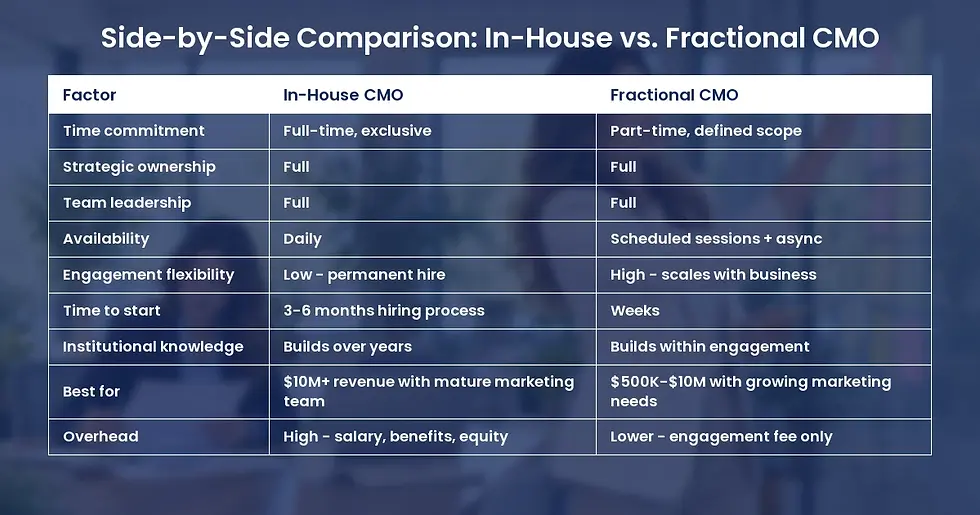
Here's where the two models actually differ in ways that matter to your decision:
Factor | In-House CMO | Fractional CMO |
|---|---|---|
Time commitment | Full-time, exclusive | Part-time, defined scope |
Strategic ownership | Full | Full |
Team leadership | Full | Full |
Availability | Daily | Scheduled sessions + async |
Engagement flexibility | Low - permanent hire | High - scales with business |
Time to start | 3-6 months hiring process | Weeks |
Institutional knowledge | Builds over years | Builds within engagement |
Best for | $10M+ revenue with mature marketing team | $500K-$10M+ with growing marketing needs |
Overhead | High - salary, benefits, equity | Lower - engagement fee only |
The most important column in that table is the last row. Revenue stage and marketing team maturity are the two factors that most clearly signal which model is right.
A business with $2M in revenue and a two-person marketing team doesn't yet have the infrastructure to get full value from a full-time CMO. A business with $20M in revenue, a 10-person marketing department, and complex multi-channel campaigns probably does.
Most businesses reading this post are somewhere in the middle. And for most of them, the fractional model delivers more value because the senior strategic thinking is there without the full overhead of a permanent executive hire at a stage where the business isn't ready to fully utilize one.
Is a fractional CMO less effective than a full-time CMO?
No. A fractional CMO brings the same level of strategic expertise and leadership accountability as a full-time CMO. The difference is in availability and time structure, not in the quality of strategic thinking. For businesses at the growth stage where a fractional CMO is the right fit, a senior fractional leader with real executive experience will consistently produce stronger outcomes than a less experienced full-time hire brought in too early.
When an In-House CMO Makes Sense
There are specific situations where a full-time CMO hire is clearly the right move. And it's worth being honest about them.
Your revenue and marketing team have both scaled significantly.
When your business is generating $10M or more in revenue and your marketing function includes multiple team members, channels, and vendors that need daily leadership, a full-time CMO starts to make sense. At that scale, the ROI on a senior full-time executive often justifies the investment.
Marketing is a primary driver of your business model.
If your entire business model runs on marketing, think DTC brands, SaaS companies with high marketing spend, or businesses built on paid acquisition, having a full-time executive in the seat every day may be critical to keeping pace.
You need deep, daily organizational integration.
Some business situations require a CMO who is in every meeting, available for rapid decisions throughout the week, and building long-term institutional knowledge over years. Board-facing companies, businesses in fast-moving competitive markets, or companies going through a major transformation sometimes fall into this category.
You've already had a fractional CMO build the foundation.
This is actually one of the most natural transitions we see at HALCON. A business engages a fractional CMO to build the marketing strategy, define the team structure, and establish the measurement framework. Once that foundation is solid and the business has scaled enough to support it, the move to a full-time CMO hire becomes much lower risk because the infrastructure already exists.
When a Fractional CMO Makes More Sense
For most growing businesses, the fractional model is the right choice at this stage. Here's how to recognize when you're in that category.
Your revenue is between $500K and $10M.
This is the sweet spot for fractional CMO engagements. The business has proven its model and needs real marketing strategy to scale, but a full-time executive hire at this stage often costs more than the business can extract value from given its current marketing team size and structure.
You need marketing leadership but not a full-time executive.
You have a small marketing team or you're working with external partners. You need someone above them setting direction, but you don't need a full-time CMO in the building every day. A fractional CMO gives you the leadership layer without the full-time overhead.
Your last marketing effort lacked strategic direction.
Tactics without strategy produce activity without results. If you've been running marketing that feels busy but isn't producing, the problem is usually the absence of senior strategic leadership, not a failure of execution. A fractional CMO fixes that without requiring a permanent hire.
You're preparing for growth or a major business milestone.
A product launch, a rebrand, entering a new market, or preparing for a capital raise all benefit from senior marketing leadership that's focused and engaged for a defined period. The fractional model is built for exactly this kind of high-impact, time-defined engagement.
You want execution alongside strategy.
This is where many fractional CMO models fall short and where HALCON specifically closes the gap. We'll cover this in the next section because it's the most important differentiator in the fractional model landscape.
Many of the businesses we work with in Missouri came to us having already tried to solve this with a series of freelancers or junior hires. The fractional CMO model gave them what those approaches couldn't: senior strategy connected directly to execution. You can see how this plays out for fast-growing companies in our post on why fast-growing companies are turning to a CMO outsourced model.
Let's Talk: If you're trying to figure out whether your business is at the right stage for a fractional CMO or a full-time hire, a single conversation with our team gives you a clear answer. |
The Strategy-to-Execution Gap That Breaks Most Fractional Models
Here's the thing most people don't tell you about fractional CMO engagements.
The most common reason they fail isn't the quality of the strategy. It's what happens after the strategy is built.
A fractional CMO sets the direction. They build the plan. And then they hand it to the business to execute. If the business has a strong, capable marketing team ready to run it, that works. But most businesses at the fractional CMO stage don't have that team yet. So the strategy sits in a document, execution stalls, and the engagement loses momentum.
This is the strategy-to-execution gap. And it's the reason we structured HALCON's fractional CMO service the way we did.
At HALCON, Nicole Powell's fractional CMO leadership is paired directly with our full production team. That means when Nicole builds your marketing strategy, our team can execute it immediately. Content, design, campaigns, social, all running under the same strategic direction without the business needing to hire or manage a separate execution team.
This model is specifically why our approach produces different outcomes than a solo fractional CMO. Strategy and execution stay connected under one roof. The plan doesn't sit waiting for capacity that isn't there yet.
Our post on why a fractional CMO backed by a full marketing team gets better results goes deeper on exactly why this gap exists and how the HALCON model closes it.
How do I know if a fractional CMO agency has real execution capability?
Ask directly. Find out whether the fractional CMO works alone or is supported by a production team that can execute the strategy they build. Ask what happens when the strategy needs content, design, or campaign management. If the answer is that the CMO hands off to you or to vendors you manage separately, you're taking on the execution gap yourself. Look for an agency where strategy and execution are genuinely integrated under one roof.
How HALCON Structures Its Fractional CMO Service
Here's how we close the gap the comparison table points to.
At HALCON, the fractional CMO model works because strategy and execution stay connected under one roof. Nicole Powell leads every engagement personally. She's a genuine senior marketing executive, not a generalist who picked up the title. Her 16+ years running marketing at Viacom, ESPN, ABC, FOX, MTV, and Disney means she's built functions at scale and she applies that directly to where your business is right now.
But the real structural difference is what sits behind her. When Nicole builds your strategy, HALCON's full production team executes it. Content, design, campaigns, and reporting all move without a separate handoff to another agency.
For businesses in the comparison stage deciding between the in-house and fractional models, our brand audit services in St. Louis are often the clearest first step. You get a documented picture of what your marketing is actually doing before committing to any leadership structure.
And if brand positioning needs rebuilding alongside the marketing strategy, our brand strategy solutions handle both without requiring two separate engagements.
Want This Handled For You? HALCON's fractional CMO service gives your business Nicole Powell's executive marketing leadership paired with a full production team. Strategy built and executed under one roof. See how our fractional chief marketing officer service works. |
Conclusion
Here's the honest answer to the in-house vs. fractional CMO question.
It's not about which model is better. It's about which one your business is actually ready for right now.
A full-time CMO is the right move when your revenue, your team, and your marketing infrastructure have all scaled to the point where a permanent senior executive can be fully utilized and fully justified. That's a real milestone worth working toward.
But most businesses reading this aren't there yet. And that's not a weakness. It's a stage. And the fractional CMO model exists specifically to give businesses at this stage access to the senior marketing leadership that will help them get to the next one.
So here's your next step. Look at where your business is right now, not where you hope it will be. Does your marketing have a clear strategy behind it? Is someone with genuine seniority leading your marketing function and accountable for results? Or is marketing running on improvisation and hope?
If it's the second one, HALCON's hire a fractional CMO service is built for exactly this moment. Nicole Powell's executive leadership paired with a full production team that executes the strategy she builds. No gap. No guessing. No spinning your wheels.
You can also start with our brand and marketing audit if you want a documented picture of where your marketing stands before making any leadership decision.
FAQs
What is the main difference between an in-house CMO and a fractional CMO?
The main difference is the structure of the engagement. An in-house CMO is a full-time permanent executive working exclusively for your business. A fractional CMO provides the same C-suite marketing strategy, team leadership, and executive accountability on a part-time basis. Both models own your marketing function and report to the CEO. The fractional model gives growing businesses access to that senior leadership without the full overhead of a permanent executive hire.
Is a fractional CMO cheaper than hiring a full-time CMO?
A fractional CMO engagement typically involves a lower total investment than a full-time CMO hire when you account for salary, benefits, equity, and employer taxes. But the more important question isn't cost. It's whether your business is at the stage where a full-time executive hire is the right structural decision. For most businesses between $500K and $10M in revenue, the fractional model delivers more value at the current stage of the business.
Can a fractional CMO replace a full-time CMO?
For many growing businesses, yes. A fractional CMO provides the same strategic marketing leadership, team management, and executive reporting as a full-time CMO. For businesses that need daily executive availability, deep organizational integration over years, or a permanent C-suite presence for board or investor purposes, a full-time hire may ultimately be the right structure. But for most growth-stage businesses, the fractional model delivers the same strategic outcomes with more flexibility.
How long does a fractional CMO engagement typically last?
Most fractional CMO engagements run on an ongoing monthly basis with no fixed end date, adjusting scope as the business's needs evolve. Some engagements are project-based with a defined timeline, such as a product launch, a rebrand, or a capital raise preparation. At HALCON, engagement scope and duration are agreed upon before the work begins and revisited regularly as the business grows.
When should a business move from a fractional CMO to a full-time CMO?
A business is typically ready to move from a fractional CMO to a full-time hire when revenue has scaled significantly, the marketing team has grown to the point where it needs daily executive leadership, and the business has the infrastructure to fully utilize a senior full-time executive. One of the most effective paths is using a fractional CMO to build the marketing foundation first, then making the full-time hire into a function that already has clear strategy, team structure, and measurement in place.
Does HALCON Marketing Solutions offer fractional CMO services?
Yes. HALCON's St. Louis fractional CMO service is led by Nicole Powell and backed by a full production team. That combination is what makes this model different from a solo fractional executive. The strategy gets built and executed under one roof. For businesses in the middle of the in-house vs. fractional decision, that integration is often the deciding factor. You can see the full engagement structure on our fractional CMO services page.
What makes HALCON's fractional CMO service different from other options?
The integration of strategy and execution under one roof. Most fractional CMO models hand you a plan and expect your internal team to run it. HALCON's model keeps both connected. Nicole Powell leads the strategy and our production team executes it directly. The result is a marketing function that moves without waiting for internal capacity to catch up.
How do I decide between hiring a fractional CMO or building an internal marketing team first?
Build the strategy before you build the team. A fractional CMO defines what your marketing team needs to look like, what roles you actually need, and what those roles will execute against. Hiring an internal team without that foundation means hiring people to improvise. A fractional CMO gives you the strategy first, and in many cases can lead the process of hiring and onboarding the internal team once the strategic direction is clear.




Comments